Products
Detect it. Suppress it. At the source.
FirePro generators, controllers and detection, engineered into the machine or the room it sits in. LPCB certificated, all electrical, and a 15 year lifespan.
How FirePro works
A solid compound, not a gas
LPCB certificated generators
Cylinder units for cabinets. Box units for rooms.
Cylindrical generators fit inside machinery and control cabinets. Box generators protect larger enclosures and rooms: generator halls, battery rooms, switchrooms.
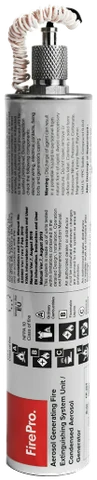
FP-20T
20 g of agent for very small and compact enclosures.
fireprouk.com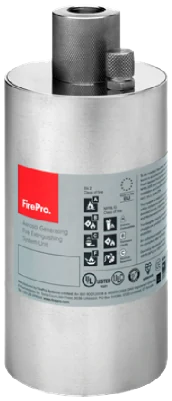
FP-200s
200 g of agent for small to medium enclosures.
fireprouk.com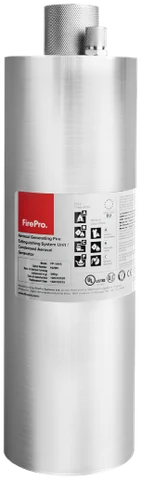
FP-500S
500 g of agent for larger cabinets.
fireprouk.com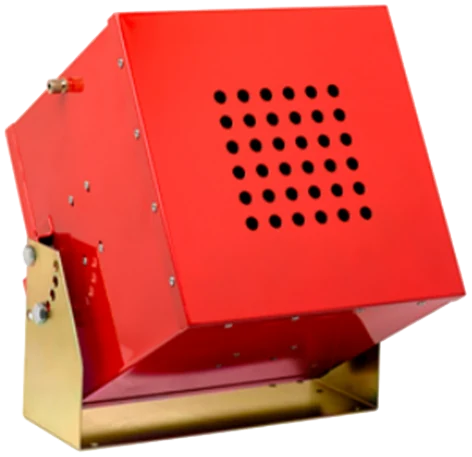
FP-4200
4,200 g of agent for medium to large enclosures.
fireprouk.comFP-5700
5,700 g of agent for large enclosures.
fireprouk.comA selection from the range. FirePro makes more generator sizes than the five shown here, which are picked to show the range of volumes FirePro can protect. FirePro agent density is calculated on a gross volumetric calculation and the class of fire, so every system is designed to suit the enclosure. See the full range on fireprouk.com
Detection & control
One fire signal. Everything shuts down.
A FirePro controller links detection to the generators and to the building. In the NHS installation, all of the outputs below happened at the same moment.
Inputs
Outputs
FPC-2V2 controller
- Linear heat cable, smoke detectors or both on one monitored input
- Four generator outputs, each monitored for faults
- Volt-free fire and fault contacts to plant or monitoring
- Battery-backed 24 V DC supply
FPC-4R controller
- Linear heat cable on one monitored input
- Two generator outputs, each monitored for faults
- Detects fire and triggers the generator automatically
- For electrical cabinets and similar enclosures
A selection from the range. FirePro supplies more controllers and accessories than the two shown here, including the FPC-5 V2 stand-alone thermal activation module and the BTA, thermocable linear heat detection, smoke, heat and UV flame detectors, and manual release units. We specify the controller and accessories to suit each machine or enclosure, and how it needs to connect to the building. See the full range on fireprouk.com
Control selector
Which FirePro control do I need?
Answer two to four quick questions about what you are protecting and what should happen when a fire starts. We will point you to the right control, with a guideline price.
What are you protecting?
Pick the closest match. Protecting several? Start with the most common one.
When a fire starts, what needs to happen?
Stand-alone controls detect and put out the fire on their own. Interfaced controls can also tell people, report faults and shut things down.
Would you need to know if it went off?
Think about whether the equipment is unattended or business-critical, and whether someone must be told about a fire or a fault.
Do you need a device with no batteries to check?
Both stand-alone options detect a fire and release the generator, with no wiring to the building.
Is there a fixed 24 V supply at the enclosure?
Or mains power nearby that a 24 V supply could run from.
Do you need any of these?
Smoke detection, more than one generator, sounders or strobes, or full fire and fault outputs.
BTA
Detects heat and releases the generator. No signalling or monitoring.
You need the fire put out with no signalling or shutdown, and a device with no batteries to check.
The BTA isn’t offered for small panels, so we recommend the FPC-5 V2 instead.
FPC-5 V2
Thermal module with a bimetallic sensor. Detects and releases only.
You need the fire put out with no signalling or shutdown, so a stand-alone thermal control is the simplest, lowest-cost choice.
FPC-4R
Linear heat detection cable with an internal 3 V battery, so no fixed power is needed.
You need the system to signal, and either there is no fixed 24 V supply at the enclosure or heat detection is all you need.
FPC-2V2
24 V panel. Linear heat and/or smoke detection, four monitored generator outputs, fire and fault contacts.
You need more than heat detection and release: smoke detection, several generators, sounders or strobes, or full fire and fault outputs.
Lithium-ion needs a specific risk assessment
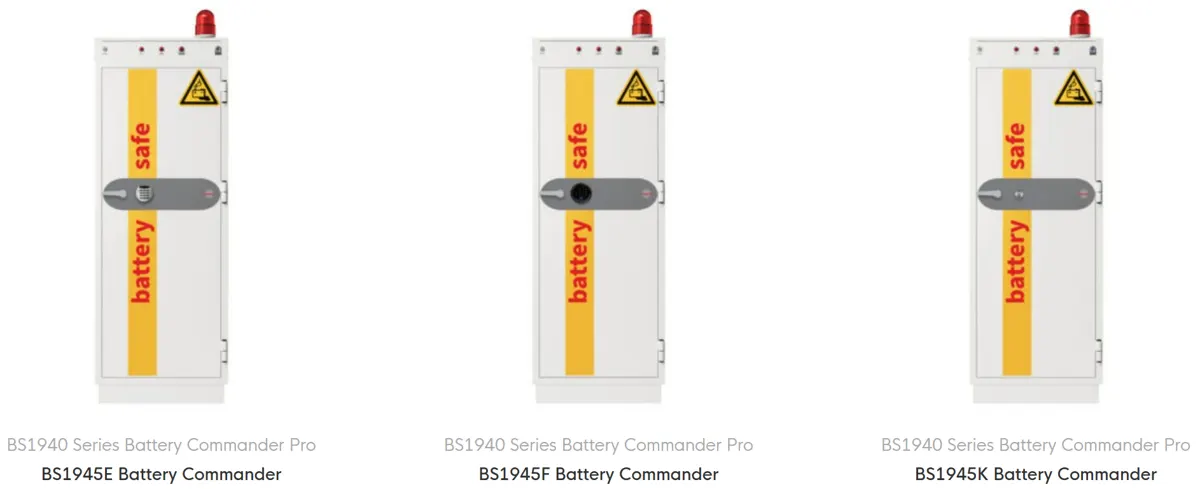
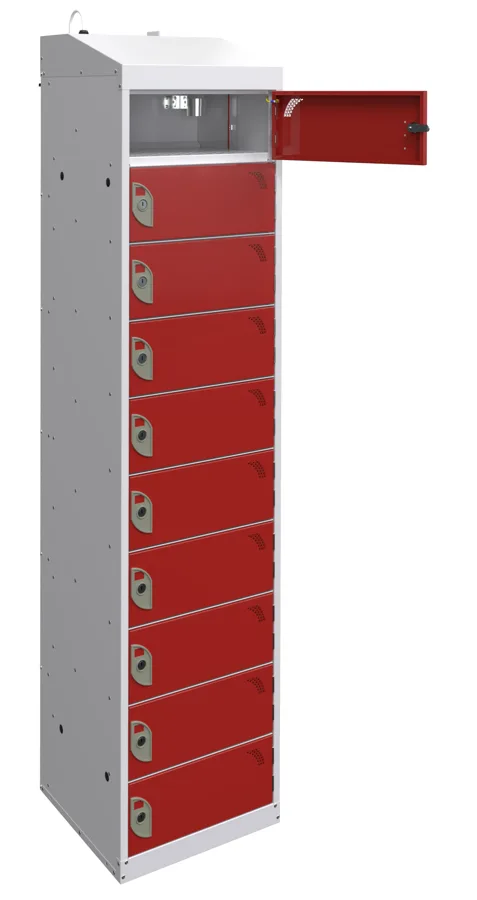
Lithium-ion batteries behave very differently in a fire, so they need their own assessment. See our lithium-ion site for charging safes, suppression lockers and engineered systems, or talk to us.
Let’s design it with you
Rooms, production lines and multiple enclosures are designed to suit the space and the fire risk. Tell us what you need to protect and we will recommend a system. Volume discounts are available.
Guideline in-cabinet pricing
Safety. At what cost?
Guideline equipment prices per enclosure, for the two ways to protect it. Installation is quoted by your chosen installer.
| Enclosure type | Example size (mm) | Example volume | Option A: Stand-aloneReleases at a set temperature. No signalling. | Option B: InterfacedReleases on smoke or temperature, with external signalling. |
|---|---|---|---|---|
| Small panel | 600 × 400 × 250 | < 0.1 m³ | £190 | £145 – £640 |
| Electrical cabinet | 800 × 600 × 1,000 | < 0.5 m³ | £265 – £325 | £245 – £735 |
| UPS lead-acid battery cabinet | 600 × 800 × 1,900 | < 1 m³ | £475 – £545 | £420 – £915 |
| Vending machine | 1,830 × 900 × 850 | approx. 1.4 m³ | £565 – £630 | £610 – £1,100 |
| Large / double bay | 1,200 × 600 × 2,000 | < 1.5 m³ | £570 – £650 | £610 – £1,100 |
| Your enquiry | Submit via WhatsApp | Any | Get in touch | |
Notes to be read with the table above
- These are guideline prices only. They exclude competent installation labour and any other equipment.
- Guideline prices are per enclosure. For multiple enclosures, please enquire: volume discounts are available.
- Installation pricing can be obtained from any approved installation ambassador. Contact us and we will put you in touch.
- Labour rates may vary with region, access, working hours and other site factors.
- The contract is between the installer and the customer. FirePro equipment is supplied to the chosen installer only.
- System design, installation, commissioning, handover and maintenance are the responsibility of the installer.
- Option A, stand-alone: suppression inside the enclosure releases at a set temperature threshold, with no signalling or interface.
- Option B, interfaced: suppression inside the enclosure releases at a set smoke or temperature threshold, with external signalling.
- Protection for lithium-ion batteries needs a specific risk assessment. Please enquire.
- Enclosures must be reasonably sealed. Vents or forced airflow may need extra agent and/or a fan shutdown.
- Prices exclude VAT and delivery, and are correct as of November 2026.
Charging batteries?